Six board games for two – from Tic-Tac-Toe to Dominoes
The board game pavilion has six games for two players: Tic-Tac-Toe, Connect Four, Reversi, Checkers, City Blocks and, new in November, Dominoes. You can play each one against the computer or take turns with a friend on the same device. Most people know the rules already, but the games differ a lot in how long a game lasts, how far ahead you have to think and whether luck plays a part.
The quickest: Tic-Tac-Toe and Connect Four
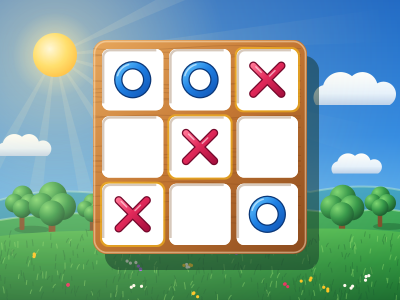
Tic-Tac-Toe is the pavilion’s shortest game. On the small 3 × 3 board you need three in a row, and on the big 5 × 5 board four. The hard computer plays the small board perfectly, so a draw is the best you can get there. Only your winning streak against the hard computer counts as your best score, so streaks are built on the big board, where a fork can catch even the hard computer out.
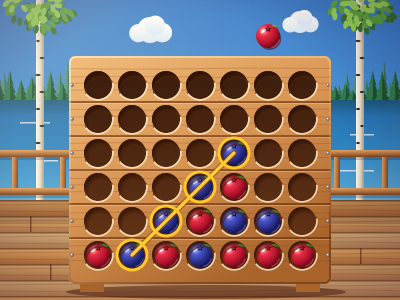
In Connect Four you drop berries into a crate of seven columns and six rows. Gravity makes it a different game from Tic-Tac-Toe: every berry opens a slot above it, and the game is often decided by who first has to drop into the wrong column. The computer has three levels, and a win in a series scores one to three points by level.
The long games: Reversi and Checkers
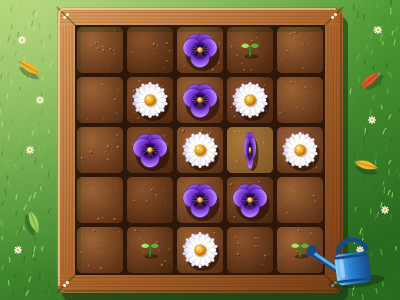
Reversi and Checkers are both played on an 8 × 8 board, and in both the position can still turn at the end. In Reversi you turn your opponent’s flowers into your own by trapping them, and whoever has more flowers wins. Seedlings show where you can plant, so the rules are easy to learn, though the game itself takes thought: the corners are worth the most, and turning many flowers at once doesn’t always pay.
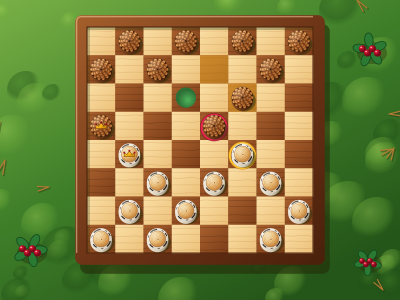
Checkers has the pavilion’s most exact rules. Capturing is required, you must take as many pieces as you can, and a king moves any distance along a diagonal. Required captures make traps part of the game: a piece you sacrifice can force your opponent into a move that lets you take two back. A win against the hard computer scores four times the points.
City Blocks: simple rules, a deep endgame
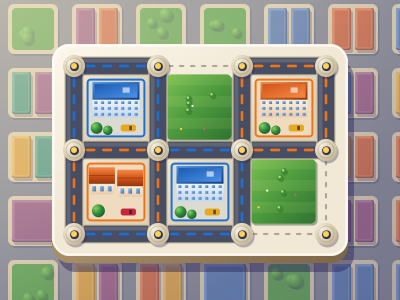
City Blocks is dots and boxes on city streets. The rules fit in a sentence: build one street on your turn, and if you close a block, it is yours and you get another turn. You can choose a city of 3 × 3, 5 × 4 or 7 × 5 blocks, and a draw is possible only in the middle size, because the others have an odd number of blocks.
City Blocks looks like a children’s game, but its endgame is about counting chains: which of you has to open a long chain for the other. The hard computer plays the chains well, so beating it means knowing when to leave the last two blocks of a chain to your opponent yourself.
Dominoes: the only one where luck plays a part
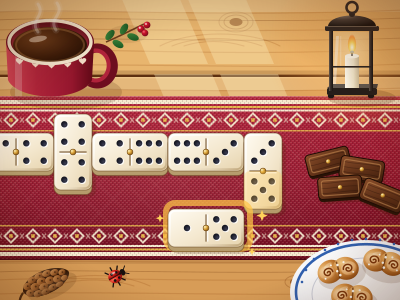
In Dominoes each of you gets seven tiles, and the other 14 lie face down in the boneyard. You can’t see your opponent’s tiles, and a tile drawn from the boneyard is a surprise, so Dominoes is the only game for two in the pavilion where the deal matters. Skill still counts: when your opponent draws from the boneyard, you know which numbers they lack, and you can keep those numbers open at the ends of the chain.
A match is played to 100 points, so it lasts several rounds. Against a friend, your own tiles show only when you press a button after the device has been handed over, so sharing one device works without peeking.
Which game suits you?
- Tic-Tac-Toe suits a short moment and the youngest players.
- Connect Four suits you when you want a quick game where you think a couple of moves ahead.
- Reversi and Checkers suit you when you have more time and want a game where the lead can still change at the end.
- City Blocks suits you when you want simple rules and still a tactical endgame.
- Dominoes suits you when you want a little chance and a match of several rounds.
All six are saved as you play, so you can finish a game later. They work on a computer, a tablet and a phone.