Three card games in your browser – Solitaire, Pyramid and Sevens
The board game pavilion in the park has three card games, all played with an ordinary 52-card deck: Solitaire, Pyramid and Sevens. The first two are patience games you play alone, and Sevens is a party game with three opponents at the table. The deck is the same, but the games could hardly be more different.
Solitaire: calm and considered
Solitaire is the familiar Klondike. Cards are stacked in seven columns in descending order with red and black alternating, and the goal is to build all the cards up by suit on four foundations from ace to king. You turn one or three cards at a time from the stock, and you choose which when you start a deal. Turning one card makes the game easier, turning three makes it harder.
Solitaire gives you time to think. Undo is free, so you can try a doubtful move and take it back. Almost every deal can be won, because the game checks before dealing that a route to victory exists. Most of the time ordinary sensible moves are enough, and you don’t have to guess what lies under the face-down cards. Scoring follows the classic Windows Solitaire, and a fast win adds a time bonus.
Pyramid: quick sums
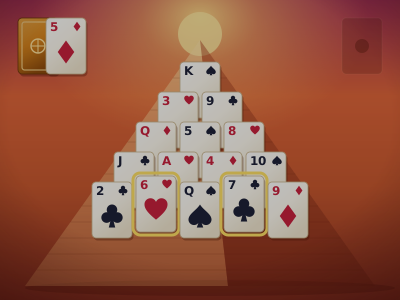
In Pyramid, 28 cards are dealt into a pyramid of seven rows, and you clear it by removing cards in pairs. A pair has to add up to 13: an ace is 1, a jack 11, a queen 12, and a king goes on its own because it is 13 already. Only cards with nothing on top of them are in play. You can go through the stock three times.
Pyramid is the patience game for those who like mental arithmetic and a brisk pace. When you clear a pyramid, the next deal continues the same run, so your score grows deal by deal. A time bonus rewards quick solutions. When no pairs are left, the deal ends at once, so there’s no pointless turning through the rest of the stock.
Sevens: a party game without the party
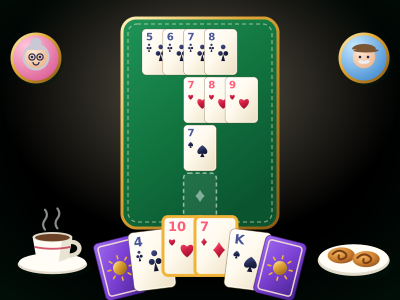
Sevens, also known as Fan Tan, is called Ristiseiska in Finland, “the seven of clubs”. There are four players: you, Grandma, Grandpa and Cousin, with 13 cards each. Whoever holds the seven of clubs starts, and cards of the same suit are played next to the sevens in order, down to the ace and up to the king. If you can play, you must. If you can’t, you ask the previous player for a card, and they choose which card to give you.
The first player to get rid of all their cards wins the round. The deal matters a lot, but so does tactics: you can hold back a seven, or a card that would open a row, until you have cards of your own behind it. A game lasts five rounds, and your opponents play a little smarter each round.
Which game suits you?
- Solitaire when you want to think things through and fix your mistakes with undo.
- Pyramid when you want quick decisions and some mental arithmetic.
- Sevens when you’d like opponents and the suspense of who empties their hand first.
All three save after every move, so you can finish a deal later. They work on a computer, a tablet and a phone. If a game is new to you, it explains one rule at a time during your first deals, just when you first need that rule, and highlights the cards the tip is about. Players who already know the rules see no tips.